
Case Study
Restoring operational coherence in an accreditation-led professional services education firm
Context
This case study describes work with a globally distributed professional services firm, that delivers leadership and coach training, as well as organizational culture programs, across digital and facilitated formats for both B2B and B2C audiences. A significant proportion of its programs fed into external accreditation frameworks, adding regulatory and quality constraints on top of an already complex delivery model.
The work unfolded over several years and spanned multiple initiatives. I led the program end to end, with targeted support from an external consulting partner during the early diagnostic and design phases. Overall program leadership, system selection, implementation, and change management sat with me throughout.
By the time the work began, the organization was performing strongly. However, growth, combined with the shift from predominantly in-person to virtual delivery, had begun to expose limits in existing operational structures.
This case study describes the end-to-end work. Separate deep dives on the CRM and LMS will follow, exploring those streams in more detail.
The challenge
The organization was struggling because effort had begun compensating for missing structure.
At its core, the challenge was a loss of operational coherence. No single, reliable way to see how work flowed end to end, who owned which decisions, or how systems, data, and roles reinforced one another.
Key symptoms included:
Disconnected platforms across marketing, sales, delivery, and finance
Fragmented B2B and B2C learning journeys held together through manual coordination
Increasing customer queries caused by unclear handovers and next steps
Critical information spread across tools, spreadsheets, and people’s heads
Forecasting and planning reliant on intuition rather than shared visibility
Growing dependence on individual heroics to keep work moving
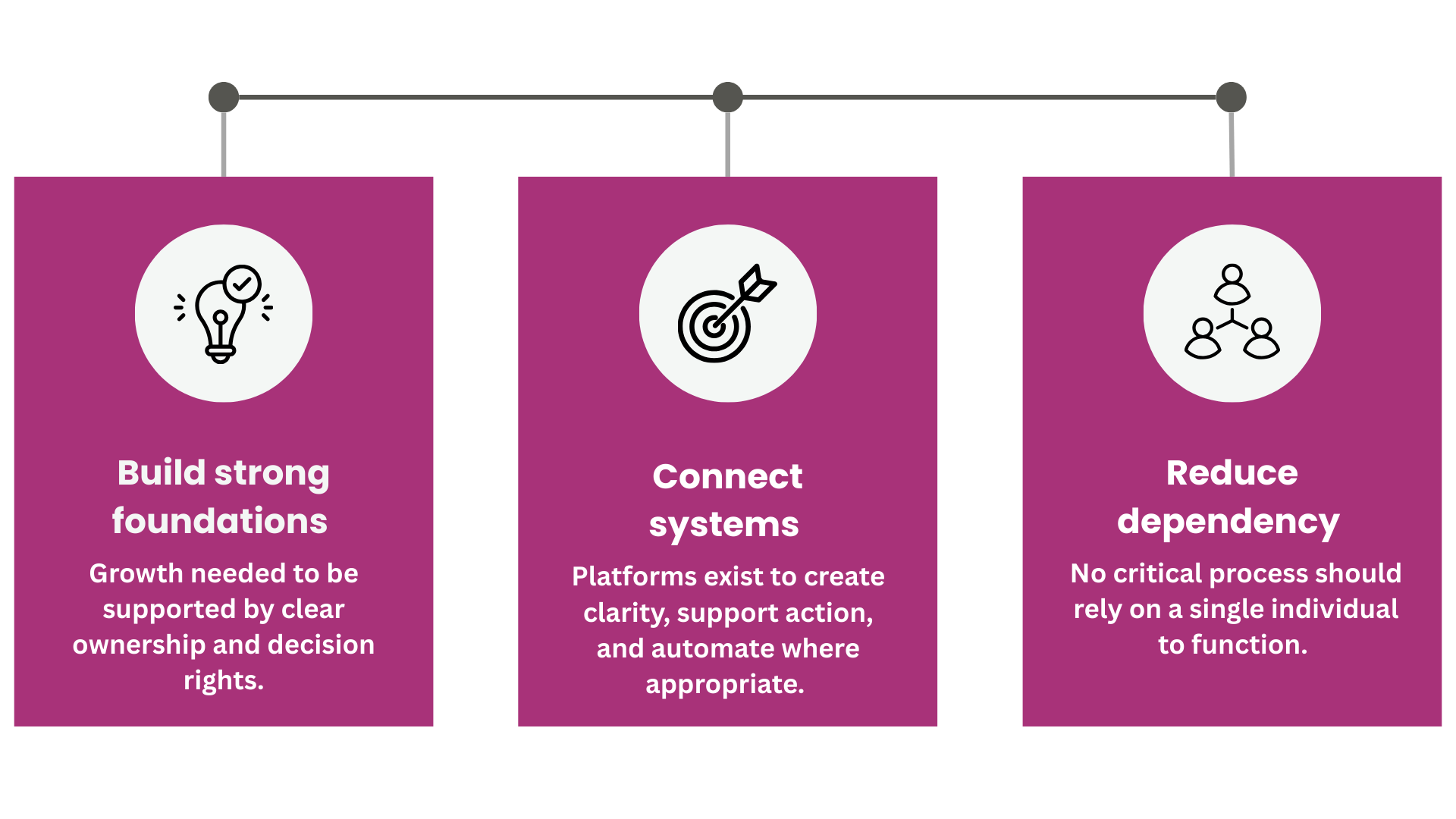
Operating principles
Before the work began, a small set of operating principles was established to guide the approach.
These principles shifted the focus away from isolated fixes and towards restoring coherence across people, processes, and systems.
The journey
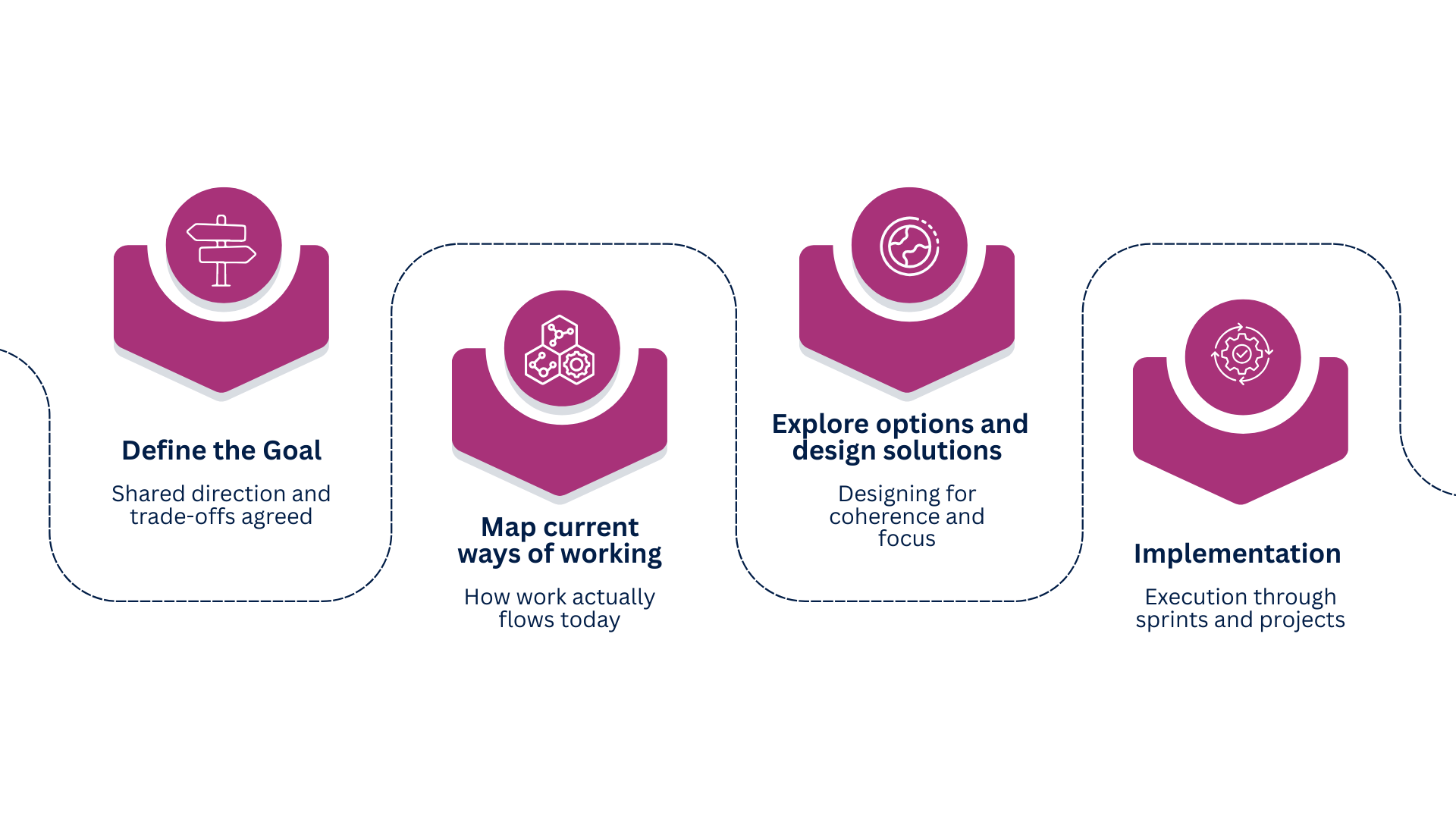
The work unfolded deliberately across four phases, combining cross-departmental insight with external perspectives from associates, clients, as well as independent research.
As is often the case in growing organizations, this work unfolded alongside other strategic initiatives and evolving priorities.
The approach was adapted accordingly, with sequencing and scope adjusted to stabilize the organization under pressure and establish the foundations needed to move forward.
Digital ecosystem
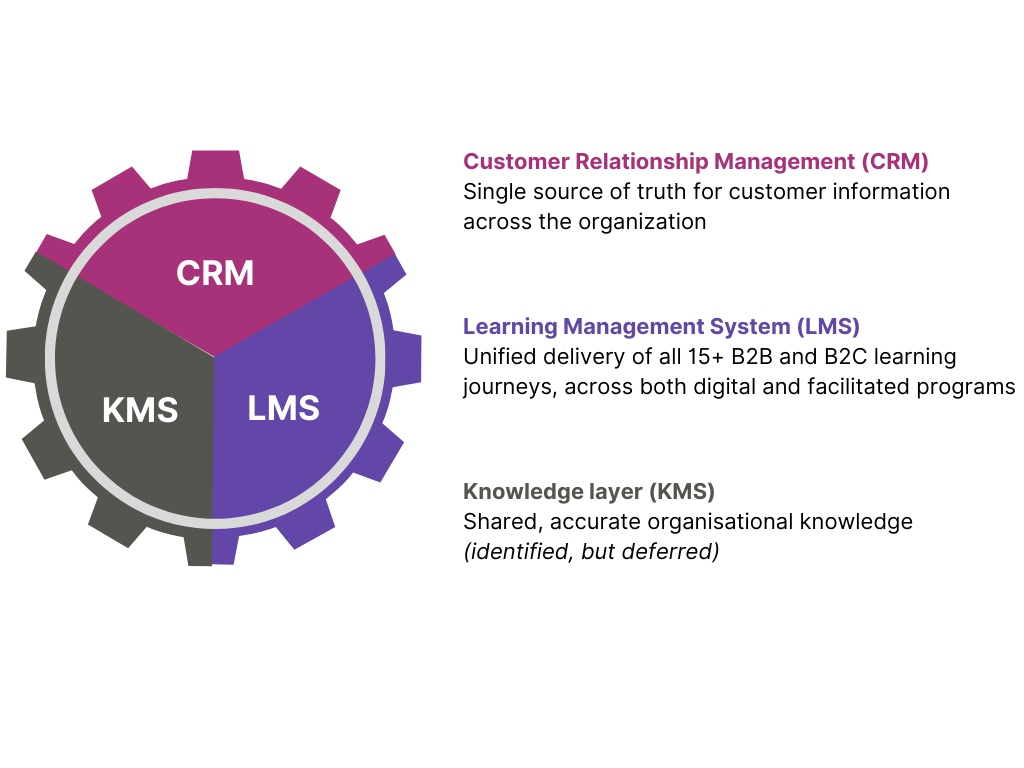
A key outcome of the early diagnostic work was the identification of the need for a consolidated digital ecosystem to restore coherence and reduce reliance on manual coordination.
Change support was treated as a core part of delivery. The focus was on practical clarity: what was changing, why it mattered, and what it meant for day-to-day work.
Selected team members were embedded directly in design and implementation, ensuring solutions reflected operational reality and could hold in practice. This was reinforced through workshops, targeted training, and updated documentation, alongside a coaching-informed approach that worked with individual strengths, constraints, and goals.
Outcomes
Organizational Structure
Structure aligned to the organization's growth stage, including outsourcing
Clearer roles and decision ownership, reducing structural ambiguity
Cultural constraints around decision-making surfaced, separating system design from leadership behaviour
Digital Ecosystem
CRM embedded as a single source of truth for customer information
LMS established as the single delivery platform for all program
Streamlined workflows and improved cross-team collaboration
Delivery experience
Coherent B2B and B2C learning journeys, digital and facilitated
~50% reduction in manual errors in day-to-day operations
~80% increase in operational efficiency driven by clearer workflows
Business impact
Five-figure cost savings (GBP)
Improved forecasting and reporting accuracy
Stronger cyber security and data protection positioning
Reflections
This work modernised legacy operations by strengthening what already worked well and removing accumulated noise.
The CRM and LMS implementations were visible milestones, but they also reflected a deeper shift: from manual, effort-heavy coordination towards more connected, digital ways of working.
The program unfolded alongside multiple other strategic initiatives. Competing priorities placed real limits on organizational capacity and shaped what could be completed within the available time and energy. Some elements, including the knowledge layer and selected system enhancements, were identified but deferred. Taken together, this highlighted the importance of pacing change as carefully as it is designed.
Finally, the work reinforced the value of an external point of view. Distance from day-to-day operations makes it easier to surface assumptions, challenge what has become normal, and see the system as it really is. That belief, that clarity often comes from thoughtful external perspective combined with sustained ownership and human-centred transformation, sits at the heart of why I created Nexus Obrada.
I have written separately about recognizing when operational foundations no longer fit, and how to assess them without defaulting to isolated fixes.
This case study describes the end-to-end work. Separate deep dives on the CRM and LMS will follow, exploring those streams in more detail.
Let’s work together
If you’re navigating increasing complexity and would value a conversation, get in touch, or explore my work as a Fractional COO and Executive Coach.